
Current state: not in service

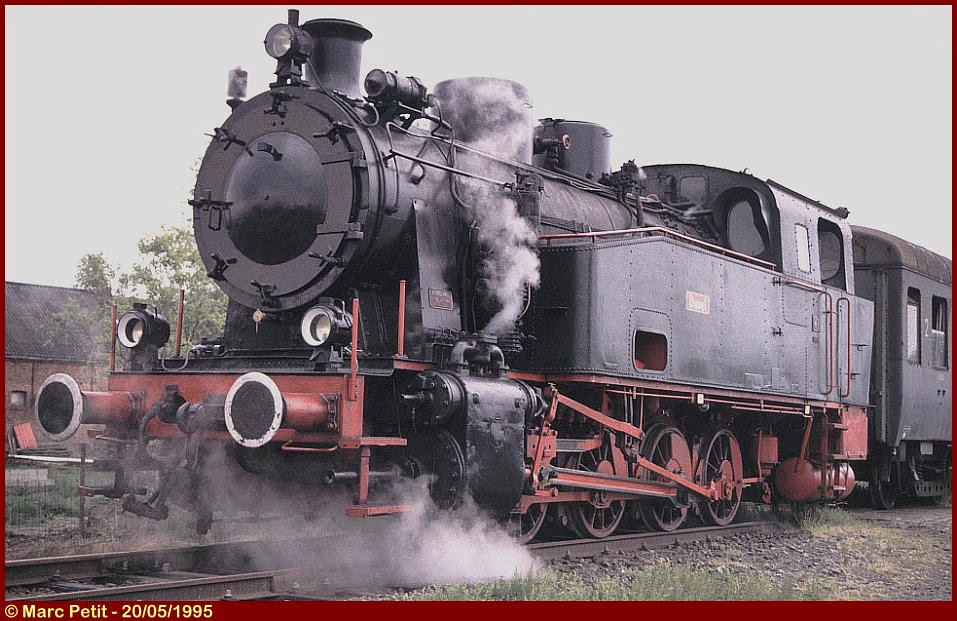
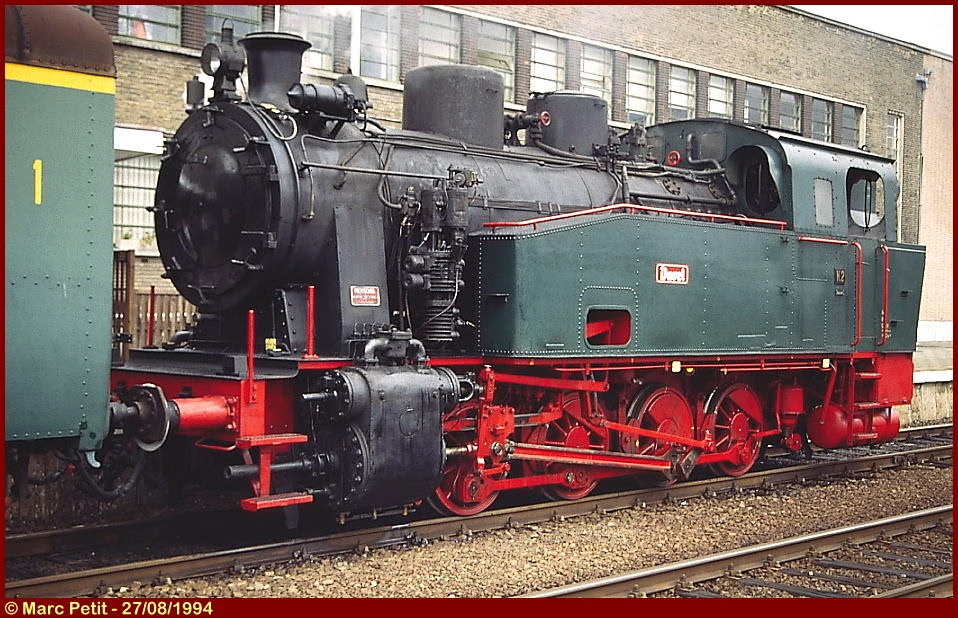
Locomotive Duvel was built in 1946 at Henschel & Sohn's factories in Kassel, Germany. Henschel started as a steelworks in 1810, producing with a wide variety of goods, from cannons to steel bridges. With the invention of the steam locomotive and its entry into Germany, the firm started building the first Henschel steam locomotives in 1844. The firm caught on and experienced great success; many of their locomotives were also sold internationally. But they also built many locomotives for the German state railways, Deutsche Reichsbahn. Cars, trucks, tanks and fighter planes were also added to their catalogue as the years passed. It should therefore come as no surprise that the company was involved in the German war machine during the 2 world wars.

During World War II, many suppliers were sold below market value based on the ethnicity of the owners. Henschel then bought up many of them. As the war progressed, Henschel's production focused more and more on war vehicles. The factories also received 6,000 forced labourers. In 1943, the factory was badly hit along with the rest of Kassel during an Allied bombing raid, 7,000 to 10,000 people were killed in Kassel. In May 1945, the US army seized the site. Despite the almost complete destruction, the army was still able to restart the repair and production of locomotives. Given that Henschel was a major arms manufacturer for the German army, they were not trusted to build smaller industrial locomotives for private individuals until 1946.

So it so happens that locomotive 29884 would roll out of the factory that same year. She was of the Henschel D600 design with 4 coupled axles (axle layout D) and rated 600 hp, hence the name. The design was completely new from after the war. Despite the difficult times in which she was created, the locomotive was still very well equipped with the latest features. She had a steam pump to brake with compressed air, an electricity generator for lighting both inside and outside the locomotive and a modern cab. The design caught on, however, the market for this type of locomotive was no longer very big. In the end, only 53 locomotives of this kind were made. Locomotive 29884 had a very varied career.


In the same year she was built she could start at the Hersfelder Kreisbahn, here she only stayed for 8 years because in 1954 she was already sold on to Ilseder Hütte. There too she did 8 years of service before being resold to Zeche Herne, there she did another 8 years and was resold again. She joined Eschweiler Bergwerksverein (EBV), here she stayed for 19 years, she was also named Anna 2 here. In 1989, she also left there. In 1990, the association BVS (Belgian Friends of the Steam Locomotive, old name of Stoomtrein Dendermonde Puurs) managed to acquire her and began a restoration that allowed her to run in 1993. Funds for that purchase and restoration were raised from a grant, the sale of locomotive Tubize 2069 to VZW Tubize 2069 and a sponsorship from Duvel Moortgat Brewery, the brewery being located in the municipality of Puurs-Sint-Amands. That sponsorship also determined the name of the locomotive, when she finally ran in 1993, it was under the Duvel name and in her original livery.

In a strange way, however, it was in her second life with the association that she would ride the shortest, just four years. In those four years, she performed the work done before this by Cockerill 2643. Duvel offered more power where the association could use it. Also at that time, BVS was still allowed to drive as far as Dendermonde station, allowing Duvel to appear before the public with much show in one of the larger Belgian stations. After its four years, though, it was really done. There was damage to the boiler, damage that had been known about when the locomotive was purchased and, above all, damage that would cost more for a repair than the locomotive was worth. Duvel was set aside and it was opted to run Cockerill 2643 again. Until today, Duvel has remained sidelined with no intention of restoring her, it is not our best piece in the fleet because it is not old, not unique and not Belgian. There are still 9 Henschel D600 locomotives in existence today, a few of which are still running such as 29893 at "Schluff" and 29892 at Museums-Eisenbahn-Club Losheim.


| Mass | 65.9 tonnes |
| Year of construction | 1946 |
| Maximum speed | 40 km/h |
| Power | 600 HP |
| Factory no. (Henschel serial number) | 29884 |
| Stock | 2500 kg coal 6000l of water |
| Axle layout | D |
| Builder | Henschel & Sohn |
| Operating principle | Horizontal boiler with flame pipes |
| Max. operating pressure | 12 bar |
| Flame tubes | steel 253 units |
| Fire box | Copper 2.2 m² (grille area) |
| Boiler | Steel Total heated area: 126.5m² |
| Water filling system | 2 injectors |
Photo gallery



 EN
EN  NL
NL  FR
FR  DE
DE